


Music may play a role in how babies begin to understand language, according to new research examining how infants respond to rhythm and sound.
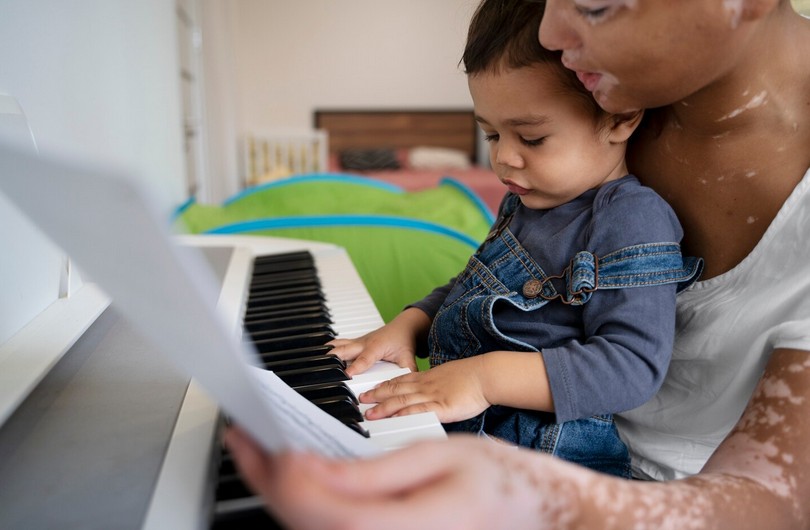
A study published in the journal of Developmental Science found that infants who are better at detecting rhythm in music also tend to be better at recognizing patterns in speech. This ability helps babies begin to learn words.
“Both music and language are built on patterns—beats group together in music the same way syllables group together into words in speech,” Jordyn Koveleski Gorman, a pediatric speech-language pathologist, child development expert, pediatric feeding specialist, and founder of the online resource hub Eat Play Say told Parents in an interview.
Gorman continued, “So if a baby’s brain is good at finding and tracking patterns in sound, that skill can also support early language learning.”


Dr. Rachel Albert, PhD, a professor of psychology at Lebanon Valley College and director of the LVC Baby Lab, echoed Gorman’s sentiments.
“Babies are born pattern detectors,” she said, “and this study highlights the parallels between music and language, both of which contain highly patterned sounds.”
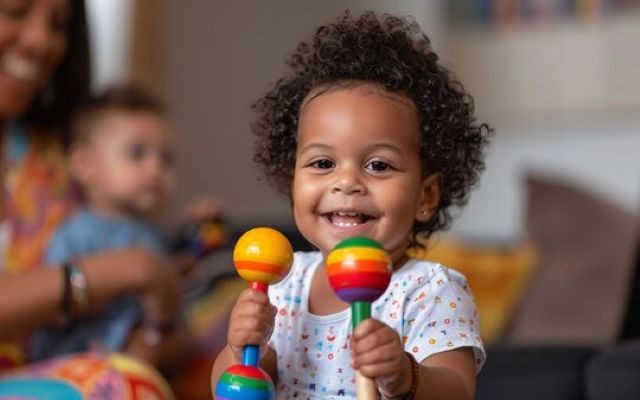
Researchers observed 44 infants between 6 and 9 months old. To conduct the study, babies wore EEG caps that measured brain activity while they listened to two types of sound: made-up speech with repeating syllables and simple musical rhythms.
“EEG studies involving infants are always challenging, because the infants need to wear a cap with electrodes and cables attached to it on their head during the session,” explained lead author Iris van der Wulp to Parents. To help keep them comfortable, babies sat on a parent’s lap and played with toys during testing.
The results showed that babies whose brainwaves synchronized with musical rhythm also synchronized with repeating word patterns in speech.
“Infants who accurately synchronized their brainwaves to the meter of a musical rhythm also accurately synchronized their brainwaves to words in an artificial language,” van der Wulp stated. “This indicates that there is indeed an overlap in the way that infants process music and language.”
The study also challenged the idea that rhythm skills are inherited. “It had previously been proposed that musical rhythmic abilities are genetically heritable,” van der Wulp said. “However, we did not find evidence that this was the case.”
Instead, babies whose parents reported making music with them more often showed stronger rhythm skills. “Based on these results I would recommend parents to spend time making music and listening to music together with their child, as our results indicate that this can be beneficial to both their child’s musical and linguistic development,” van der Wulp added.
“You don’t need to be musical. You don’t need to sing on key,” Gorman said. “You just need to be willing to sing, clap, bounce, and be silly with your baby.”