



The Centers for Disease Control and Prevention has released a revised childhood immunization schedule. Here’s what parents need to know.

The updated schedule marks one of the biggest shifts in U.S. vaccine guidance in years. It reduces the number of routine childhood vaccines and reclassifies several others. Dr. Jason Schwartz, a vaccine policy specialist at the Yale School of Public Health, explains what this means for parents and aims to help reduce confusion.
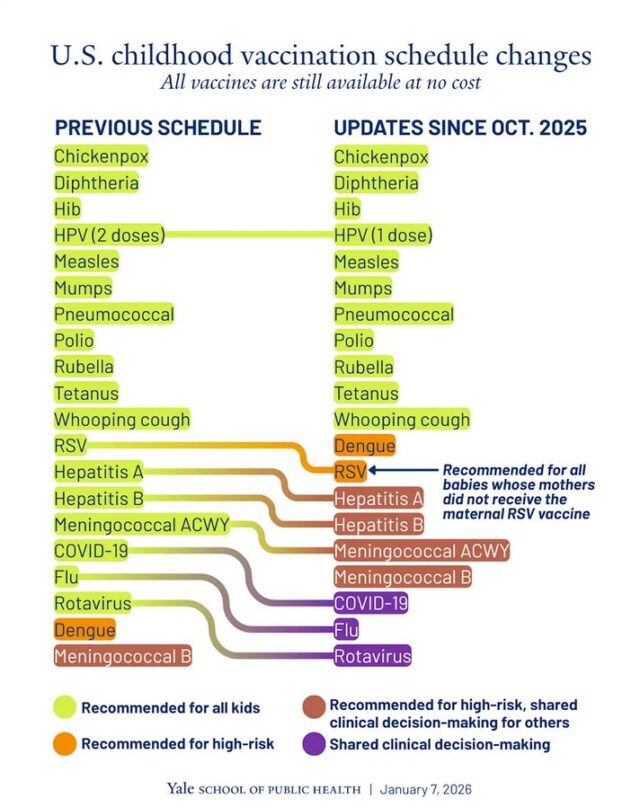
“When it comes to explaining these changes in recommendations, the short answer is that the CDC demoted several vaccines that used to be in the plain-and-simple, ‘you should get this vaccine’ category, to specialized sub-categories that have their own criteria and implications,” Dr. Schwartz said in a recent Yale School of Public Health article.


He continued, “The concern is this is going to create widespread confusion about when those ‘special-category’ vaccines should be used, which will doubtlessly mean fewer kids will get those vaccines and more kids will get those diseases.”

The updated new recommendation reduces the number of universally recommended childhood vaccines from 17 to 11 and places them into new categories.
- Chickenpox
- Diphtheria
- Haemophilus influenzae type B (Hib)
- HPV (now a single dose instead of two)
- Measles, mumps, rubella
- Pneumococcal
- Polio
- Tetanus
- Whooping cough
Several others are no longer automatic and now fall under shared decision-making between parents and physicians:
• Flu
• COVID-19
• Rotavirus
Vaccines for hepatitis A, hepatitis B, and meningococcal disease are now recommended only for children with specific risk factors or after consultation with a provider.
It is important to note that all childhood vaccines still remain available at not cost to parents.
CDC data shows that U.S. childhood vaccinations have prevented more than 500 million illnesses and over 1 million deaths in the past 30 years. Dr. Schwartz notes that vaccines shifted out of the universal category, including hepatitis A, hepatitis B, and rotavirus, protect against serious diseases that can lead to hospitalization or long-term complications.
To learn even more about this new vaccine schedule in detail, click here to listen to Dr. Schwartz’s Ask An Expert segment on KCBS radio.